Names and some identifying details in private client stories have been changed to protect their privacy. The outcomes described are real.

You became the person everyone depends on.

Now work is taking over the rest of your life.

You still want to win. You just can't keep paying for it like this.

Mirror

You've worked hard. You anticipate problems before anyone else sees them. You're the one who catches what's about to go wrong and fixes it quietly before it becomes anyone else's issue.

That made you valuable. It also taught everyone around you to lean harder.

Work follows you home. Your mind stays half-activated all evening. You spend more energy than you should on the political stuff — who's annoyed, who's threatened, who needs managing. Small conflicts trigger a bigger reaction than they deserve. Weekends have become recovery time, not your time.

There's very little left over for anything else. Relationships, health, the things you used to be curious about — they get whatever's left, which most weeks is close to nothing.

You might already suspect: this is just what being successful costs.

It isn't. The way you've been winning simply isn't working anymore.

Why the Old Strategy Stopped Working

Here's the trap.

Because you're competent, people give you more. Because you can rescue something, you do. Because you don't trust that other people will hit your standard, you carry it yourself instead of handing it off. Because you're reliable, the organization quietly starts using you as its safety net.

Each decision made sense on its own. Repeated often enough, they became the way the organization learned to use you.

Working harder used to produce advancement. Now it mostly produces more work, more dependency, more responsibility, more stress — without proportionately producing more money, more influence, more autonomy, or a better life.

Effort alone stopped being enough a while ago. You just kept supplying it anyway, because it's the one lever you know how to pull.

The Reframe

This isn't an argument for wanting less.

Not: quit your job. Not: care less about the outcome. Not: become less competent, less ambitious, less driven. Not: this is what corporate life does to everyone, escape it.

You should be allowed to win. It just shouldn't cost you everything else.

What has to change isn't your ambition. It's the strategy you're running it on.

What Winning Actually Requires Now

There is no universal way to win at work. A trading floor rewards different behavior than a mission-driven nonprofit. What gets you promoted in one company gets you sidelined in another, and nobody hands you the rulebook when you walk in.

Which means some of this is strategic, not just personal:

What does this specific environment actually reward? Who has real influence, versus who just has the title? Who's quietly on your side, and who isn't? What work is actually advancing your position, and what are you doing purely because everyone knows you'll say yes? Where should your reputation actually get built? What should you stop carrying? Is management even the right target — or the default one? Should you stay, or should you move? What are you actually trying to get out of this?

If you concentrate effort on what actually matters here, you can stay just as successful while spending a fraction of the energy on what doesn't. That difference is what gives you a life back.

Why Now

You haven't collapsed. That's exactly why this is easy to keep postponing — you're successful enough that blowing things up seems irrational.

But the evidence has been quietly accumulating. Getting passed over for something you were ready for. Compensation that's stopped moving. Responsibility that keeps growing without the authority or money to match it. Evenings and weekends disappearing into recovery instead of your actual life. Watching people around you build the parts of life you've kept postponing.

You're not failing. That's exactly why you've stayed this long — the current strategy works just well enough to keep you inside it.

The cost of waiting isn't another hard year at work. It's another year of the rest of your life staying on hold.

Why Me

This isn't "I used to coach people." I've spent most of my career seeing workplaces from different sides of the table: as the ambitious employee trying to make himself useful, as a senior leader — CHRO, GM, interim COO — deciding who was ready for more, as the person who built the performance systems those decisions ran on, as an operator inside a company scaling fast enough that nothing held still, and for years since, as an outside advisor and long-term private mentor.

About a decade inside Mindvalley's executive team, while the company grew from roughly $20M to $80M in annual revenue and expanded to 400+ people across 40+ nationalities — recognized during those years by WorldBlu, Great Place to Work, and Inc. Magazine.

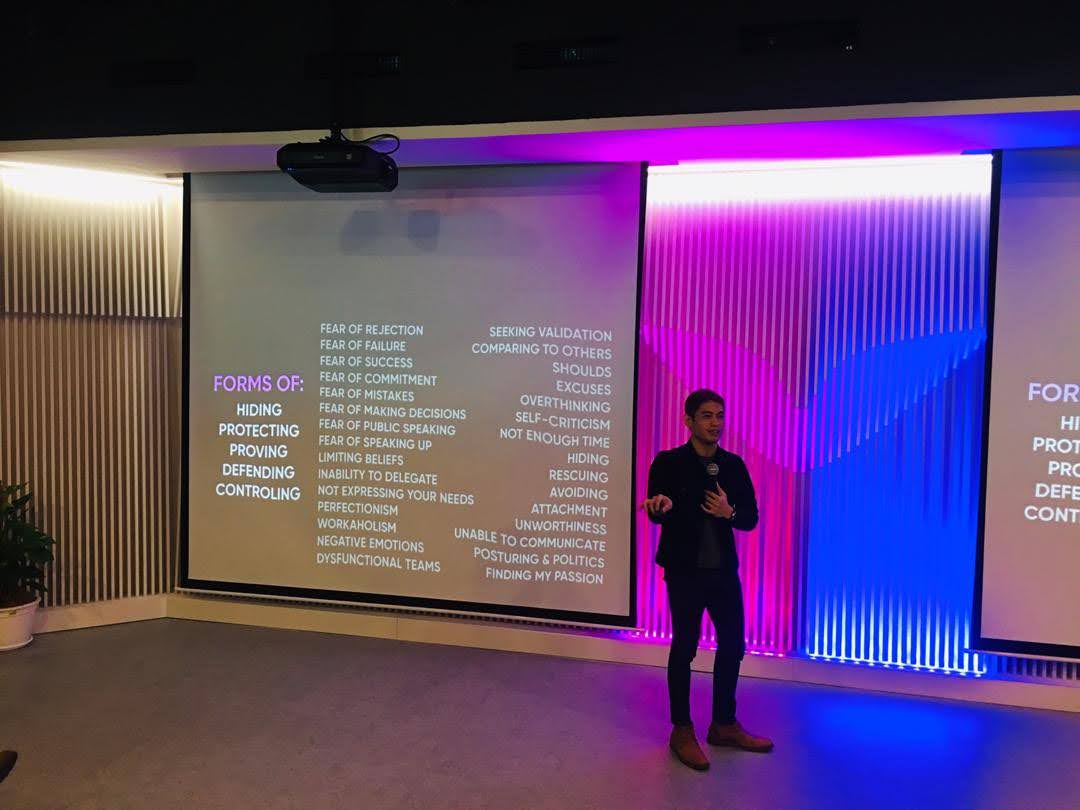
Ezekiel Vicente presenting material about hiding, protecting, proving, defending and controlling
102Senior managers and leaders mentored over the years
402People through Identity 101

What that adds up to is an unusual read on environments — formal power versus actual power, politics, incentives, where a specific person's strengths create real leverage, and where they're fighting a battle that was never winnable.

I'm not going to sit back and ask reflective questions while you find your own answers. I'll give you an opinion. I'll help you plan the actual move. When something difficult is unfolding in real time, I'm in it with you, thinking it through. This is closer to having a private strategist in your corner than it is to conventional coaching.

Flagship Case

Renata

Renata was successful by every visible measure and running on fumes underneath it. Poor sleep. Constant low-grade anxiety. Defensive by reflex in a genuinely political environment. Almost nothing left in the tank once the workday ended.

We started with what was on fire. Then we mapped the actual terrain — who had real power, who was quietly an ally, who was working against her, which projects were worth her time, which were just noise she'd inherited by default. She started redirecting effort toward what actually strengthened her position instead of everything that asked for it.

Eventually she moved to a competitor — and this time, deliberately, differently. We picked the right mentor inside the new company before she needed one. Chose projects for what they'd build, not what was loudest. Built relationships with the people who'd actually advocate for her. Flagged political risk early instead of discovering it the hard way. Concentrated her energy exactly where her strengths created leverage.

As work stopped consuming everything, the rest of her life had room to come back. She returned to singing and theatre — and that creative work ended up strengthening how she operated professionally, not competing with it.

In the two years since: promoted twice. Recognized on an industry 40 Under 40 list. Acting and singing again. Married. Now working toward becoming a mother.

In her own words:

"I was stressed. I had sleep problems. I felt trapped at work. I had no idea that two years later I'd be at my fittest, hottest, wearing a wedding dress, in love with my husband, acting, singing, and feeling untouchable at work. Oh, and I got 40 Under 40 — and I wasn't even trying. It's crazy to think what can happen in two years."

Other Proof

Sofia

was exceptional at marketing automation — good enough that other teams kept pulling her into their problems. Being needed felt like being important. It also had her working 10 to 12 hours a day for compensation and a title that weren't moving.

The work was mostly subtraction: stop automatically rescuing other teams. Strip out what wasn't advancing her actual objective. Protect the responsibilities that were genuinely hers. Make sure the work that mattered was visible to the people who could act on it. Find the people above, beside, and below her who could legitimately advocate for her, instead of assuming good work would eventually speak for itself.

Inside two years: Senior Marketing Specialist to Director of Marketing. Compensation moved repeatedly along the way, eventually landing around $15,000/month plus 20% commission. Her workday dropped to roughly 5 to 7 hours. She now works while raising a child at home.

Competence was getting rewarded with more work. The fix was never becoming less competent — it was becoming far more selective about where the competence went.


Camille

, a sales specialist, believed the only real path forward was management. What she actually wanted was more money, more autonomy, and a schedule that was hers.

Management would have taken her further from all three. So we stopped optimizing for the ladder and built the case for keeping her exactly where her performance was already exceptional — positioned deliberately as a senior individual contributor, not someone waiting to be promoted out of the thing she was best at. She negotiated commission-heavy compensation, more control over her schedule, and eventually a fully remote arrangement — while we navigated the repeated political pressure to pull her into management anyway.

She went from roughly $5,000/month to around $15,000/month plus commission. Fully remote. Moved back to Latin America, bought the property she'd wanted, and now materially supports her parents. She pursued a serious interest in modeling and physique work that management would never have left room for, and built the family life she wanted.

She didn't need a promotion. She needed a career actually designed around what she wanted.

In her own words:

"I've never thought it was possible for me to earn this much and have all the time I needed to be a mom, a wife, a bodybuilder model, and still have time to live a slower life in my dream country."

The Bigger Life Argument

Career is the entry point, not the whole territory. I work with the person operating the career, not just the career itself.

Ezekiel Vicente standing beside the Singapore skyline at night

Winning at work only counts if you still want the life it creates.

More money may be the right answer. More authority may be the right answer. Leaving may be the right answer. Marriage, children, creative work, health, freedom — any of these may matter more than the next title. The answer isn't predetermined, and it isn't automatically whatever comes next on the socially approved list. Part of the work is figuring out what you're actually trying to build toward, not assuming you already know.

The Offer

30-Day Situation Reset — US$2,000

For high-performing professionals who've become indispensable at work and are watching the rest of their life pay for it.

We start by understanding exactly what's happening. Then the work moves fast:

Ezekiel Vicente in conversation with two women around a table
01WITHIN 72 HOURS

Your Situation Map

02WITHIN 24 HOURS AFTER THAT

Your Start / Stop / Continue + immediate moves

03BY DAY 30

Your 90-Day Strategy + execution already underway

The rest of the month is working through the actual situations in front of you — roughly weekly private sessions, direct access between conversations, no artificial curriculum, no busywork. By Day 30, you'll also have a set of decision principles you can keep using, a preliminary read on how you operate, and session recordings and notes to keep.

Tell me what's happening.

How It Works

01

Before you pay, we talk. At least an hour, usually. Not the paid work itself — just enough for both of us to know whether I actually understand your situation well enough to be useful, and whether we want to work together. You should leave that conversation knowing whether I actually understand what you're dealing with — not wondering whether you've just sat through a sales call.

02

Once we agree to work together, you pay, then the real intake happens. Career history, your current role and its politics, what you actually want over the next few years, what's currently non-negotiable in the rest of your life, and two questions that matter more than they sound: if nothing changes in the next 12 months, what worries you most? And if this goes exceptionally well, what's actually different a year from now?

03

Within 72 hours of a completed intake: the Situation Map. I study what you've sent before we talk. Together, we turn what currently feels like an undifferentiated mass of problems into visible terrain — who actually has power, who's an ally, what's worth your time, what you've inherited that isn't actually yours, what's coming that you need to see early.

04

Within 24 hours of that: your operating order. What starts. What stops. What you protect because it's already working. What needs to happen this week — a conversation, a boundary, a renegotiation, a decision you've been circling.

05

The rest of the month is execution, not more diagnosis. Roughly a session a week, adjusted to what's actually happening — some weeks need a short tactical call, a real negotiation might need a longer one. WhatsApp between sessions for brief updates and things that come up; the actual work happens in conversations, not a running thread. Your life is the curriculum. If a negotiation is Thursday, that's the work. If your manager just became politically dangerous, that's the work.

The Guarantee

By the end of 30 days, you should have real breathing room, a clear understanding of what you're actually dealing with, and a defined 90-day direction.

If we haven't reached the outcome we agreed on at the start — assuming you've followed through on the actions we agreed were yours to take — you choose: I keep working with you for another month at no additional cost, or I refund the $2,000.

This covers what we can reasonably control together — not a promotion, not another person's behavior, not a company changing. It covers the intervention itself.

Tell me what's happening.

Capacity

I work with no more than five people in this intensive format at once.

Not a countdown timer — a delivery constraint. I need to actually know what's happening in your situation well enough that we're not rebuilding context every session.

After Day 30

There's no obligation to continue.

If we're done, we're done — you keep 90 days of email access for questions about implementing what we built, whether or not you continue working with me.

If having me beside you still materially helps where you're going, we decide together what that looks like next. Frequency and structure get worked out based on what's actually useful, not sold as a fixed package upfront.

Not Ready for the Full Reset?

One-off counsel is available separately at $750/session — one substantial conversation for a single decision or situation, no need for the complete Reset, no ongoing commitment.

Tell me what's happening.

Email me personally at ezekiel@ezekielvicente.com with:

Where you are now.What you want to be different.Why now.

I read every note myself. If I think I can help, I'll write back and we'll start with a conversation.

Email Ezekiel personally ↗